Business Automation & Integration Services

Manual processes, disconnected systems, and data silos silently drain productivity and slow down growth.

Our automation and integration services help businesses connect applications, automate workflows, and eliminate repetitive tasks using RPA, iPaaS, AI-driven platforms, and custom API development.
Automation & Integration Services

What Is Business Automation & Integration?

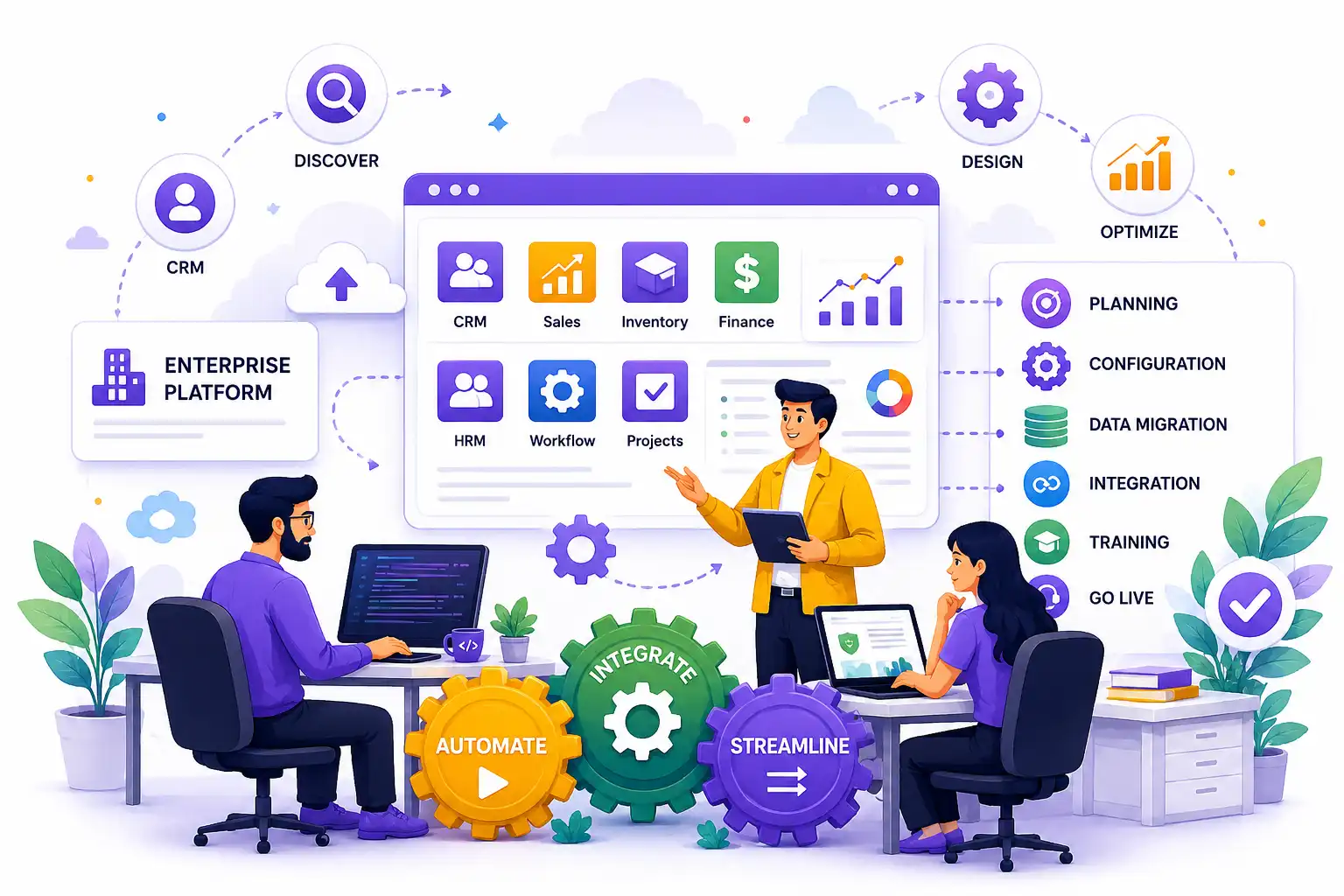
Business automation uses technology to execute repetitive tasks, enforce business rules, and trigger workflows without manual intervention. Integration connects your disparate software systems—CRM, ERP, accounting, e-commerce, and more—so data flows seamlessly and in real time.

Together, automation and integration eliminate data silos, reduce human errors, accelerate processes, and free your teams to focus on high-value work. We leverage platforms like Microsoft Power Platform, Creatio, Jitterbit, Workato, and MuleSoft alongside custom API development to deliver end-to-end solutions.

Our Automation & Integration Capabilities

Robotic Process Automation

Microsoft Power Platform RPA.

AI-Driven Automation

Intelligent workflows with Creatio.

iPaaS Integration

Jitterbit, Workato, MuleSoft.

Custom API Development

RESTful & SOAP API solutions.

Architecture Design

Enterprise integration blueprints.

Workflow Orchestration

Multi-system process automation.

Legacy System Integration

Connect old systems to modern apps.

Monitoring & Optimization

Real-time performance tracking.

Why Businesses Need Automation & Integration

Operational Speed
  • Eliminate manual bottlenecks

  • Faster order-to-cash cycles

  • Instant data synchronization

  • Reduced processing time

Accuracy & Consistency
  • Zero manual data entry errors

  • Rule-based task execution

  • Consistent process outcomes

  • Reliable audit trails

Cost Reduction
  • Lower operational overhead

  • Fewer resource-heavy tasks

  • Optimized workforce allocation

  • Faster ROI on technology

Scalability
  • Handle growing data volumes

  • Add systems without rework

  • Cloud-ready architecture

  • Future-proof integrations

Industries We Serve

Manufacturing
Manufacturing
Retail & E-Commerce
Retail &
E-Commerce
Transportation & Logistics
Human Services Delivery
Engineering & Construction
Consumer Packaged Goods
Travel & Hospitality
Ready to Automate Your Business?

Let our experts design and deploy integrations and automations that save time, cut costs, and scale with your growth.

Get Free Automation Consultation

Why Choose Us for Automation & Integration

Automation & Integration
  • Expertise across RPA, iPaaS & API platforms

  • Enterprise integration architecture design

  • Seamless legacy-to-cloud connectivity

  • Ongoing monitoring, optimization & support

Frequently Asked Questions About Automation & Integration

Robotic Process Automation (RPA) uses software bots to mimic human actions—clicking, typing, copying data—across your applications. It automates repetitive tasks like data entry, invoice processing, and report generation, saving hours of manual work daily.

iPaaS (Integration Platform as a Service) is a cloud-based platform that connects your applications through APIs for seamless, real-time data flow. You need it when your business runs multiple cloud or on-premise tools that don't talk to each other natively.

We work with Microsoft Power Platform for RPA, Creatio for AI-driven automation, and iPaaS platforms including Jitterbit, Workato, and MuleSoft. We also build custom REST and SOAP APIs for bespoke integration needs.

Yes. We use a combination of RPA (for UI-level automation on legacy systems without APIs) and API integration (for modern applications) to bridge the gap between old and new systems without requiring a full rebuild.

Cost depends on the number of systems, complexity of workflows, platform licensing, and whether RPA, iPaaS, or custom APIs are needed. We provide detailed scope-based pricing after a discovery session.

RPA automates tasks at the user interface level—mimicking clicks and keystrokes. API integration connects systems directly at the data level for faster, more scalable, and more reliable communication. Both approaches complement each other.

No. We follow a phased implementation approach—starting with process analysis, then pilot automation, and finally scaling across departments. Your teams continue working while automations are deployed alongside existing workflows.

Yes, we provide continuous monitoring, performance optimization, error handling, and enhancements for all deployed automations and integrations to ensure they remain reliable as your business evolves.