Which ERP Should You Choose: Odoo or Holded?
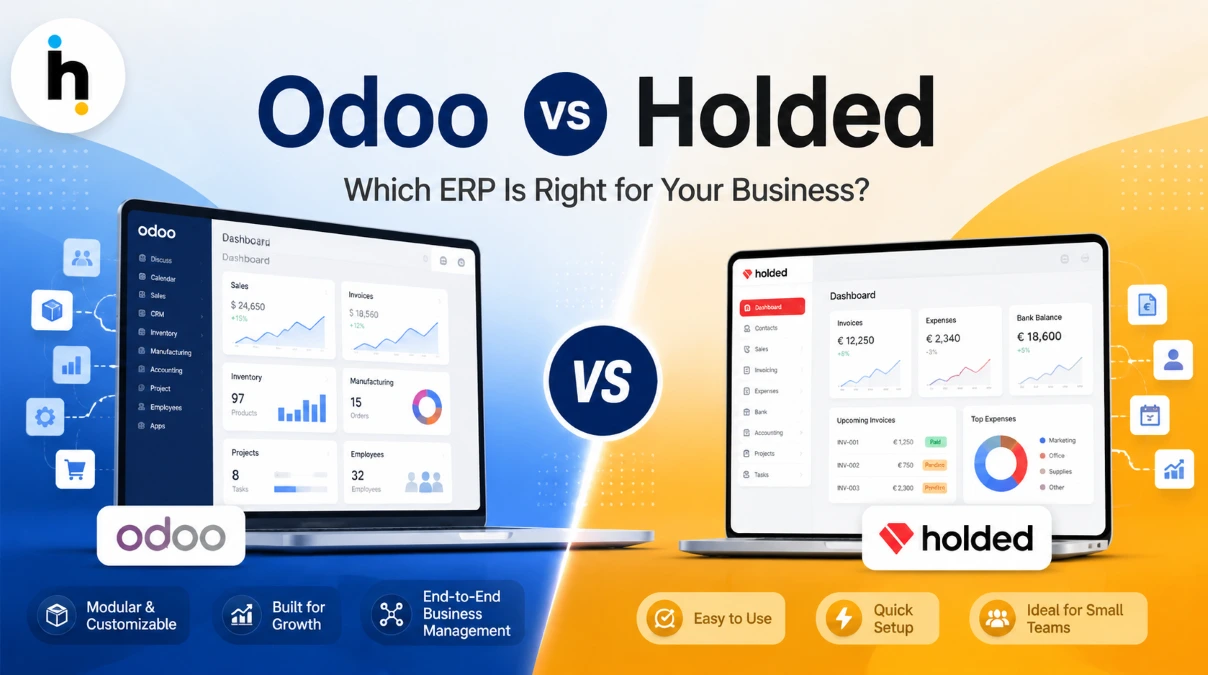
Choosing between Odoo ERP and Holded usually comes down to one question: does your business need a flexible, modular system that can grow with complex operations, or a simpler tool that covers accounting and invoicing without much setup? Both platforms are legitimate business management tools, but they were built for different situations. This article breaks down what each one does well, where each one falls short, and how to figure out which one actually matches your business today and in two years.
Odoo ERP vs Holded: An Overview
Odoo ERP is a modular business management platform made up of dozens of interconnected applications, including accounting, CRM, inventory, manufacturing, project management, HR and e-commerce. Companies can start with one or two modules and add more as operations grow, which makes Odoo suitable for businesses that expect their processes to become more complex over time.
Holded is a cloud based business management tool aimed primarily at freelancers, small businesses and startups in Spain and parts of Europe. It focuses on invoicing, basic accounting, simple CRM and project tracking. Holded is built for speed of setup rather than depth of customization, which makes it a reasonable starting point for very small teams with straightforward needs.
The core distinction is scope. Odoo is an extensible ERP system designed to run an entire company's operations. Holded is closer to a lightweight business management suite designed to keep small operations organized without a steep learning curve.
Odoo ERP vs Holded: Key Differences
The two platforms diverge most clearly once you look past basic invoicing and into how each system handles growth, customization and cross department workflows.
- Core functionality: Odoo offers a full suite of business applications that can be combined into a single connected system. Holded covers the essentials — invoicing, expenses, basic accounting, and light CRM — but does not extend into areas like manufacturing or advanced inventory logic.
- Accounting: Both platforms handle standard accounting tasks. Odoo's accounting module goes further with multi company support, detailed financial reporting and integration with other operational modules, which matters once a business needs accounting data to inform inventory or manufacturing decisions.
- CRM: Odoo's CRM is a dedicated module with pipeline automation, lead scoring and marketing integrations. Holded's CRM is functional for tracking basic client interactions but is not built for complex sales processes.
- Project management: Odoo includes task tracking, timesheets and profitability analysis tied directly to invoicing and accounting. Holded offers simpler project tracking suited to small teams managing a handful of active projects.
- Inventory and manufacturing: This is where the gap widens. Odoo supports multi warehouse inventory, manufacturing orders, bills of materials and quality control. Holded does not offer comparable manufacturing functionality, which makes it unsuitable for product based businesses with production workflows.
- Scalability: Odoo is built to scale from a five person startup to a company with hundreds of employees and multiple business units. Holded is designed around small business needs and can start to feel limiting once headcount, transaction volume or process complexity increases.
- Customization: Odoo is open and modular at the code level, allowing custom modules, workflow automation and tailored business logic. Holded offers configuration options within its existing feature set but does not support the same depth of customization.
- Integrations: Odoo has a large app marketplace and supports API based integrations with external systems. Holded offers a smaller set of native integrations, which can matter if a business relies on specialized third party software.
- Ease of use and implementation: Holded is generally easier to set up on your own, with a shorter learning curve. Odoo's flexibility comes with more implementation decisions — module selection, workflow configuration, data migration — which typically benefits from planned rollout and testing.
- Pricing considerations: Holded's pricing is usually simpler and lower for very small teams. Odoo's cost depends on the number of modules used, user count and any custom development, which can be more cost effective at scale but requires more upfront planning.
- Business complexity: Businesses with straightforward invoicing and light accounting needs may find Holded sufficient. Businesses managing multiple departments, inventory, manufacturing or complex approval workflows generally outgrow Holded's scope.
| Factor | Odoo ERP | Holded |
|---|---|---|
| Core scope | Full ERP, modular apps | Lightweight business suite |
| Manufacturing | Yes, dedicated module | Not supported |
| Customization | Extensive, code level | Limited to configuration |
| Scalability | Built for growth and complexity | Best for small, stable operations |
| Integrations | Large marketplace, API access | Smaller native integration set |
| Implementation effort | Requires planning and setup | Quick self service setup |
| Best fit | Growing or multi department businesses | Freelancers and small businesses |
When Should You Choose Odoo ERP?
Odoo tends to make sense once a business needs its accounting, inventory, sales and operational data connected in one place rather than managed across separate tools. Companies planning for growth, adding product lines, or running manufacturing processes typically need the depth Odoo provides.
Odoo customization becomes relevant when standard workflows do not match how a business actually operates — for example, industry specific approval chains or non standard inventory rules. A proper Odoo implementation accounts for these gaps early, rather than forcing the business to adapt to generic defaults.
Businesses migrating from spreadsheets, legacy software or another ERP also need to think through Odoo migration carefully, since data accuracy during the transition affects reporting and daily operations afterward. Similarly, Odoo integration with existing tools — payment gateways, shipping providers, industry specific software — often determines how smoothly the system fits into daily work.
Odoo is generally the stronger choice for businesses with modular ERP requirements, multiple departments, or workflows that are expected to become more complex as the company grows.
When Should You Choose Holded?
Holded is a reasonable option for freelancers, solo consultants and very small businesses that mainly need invoicing, expense tracking and basic accounting without a lengthy setup process. If a business has one core workflow, a small team, and no immediate need for manufacturing, advanced inventory or deep customization, Holded can keep operations organized without the implementation effort an ERP requires.
Holded also suits businesses that prioritize getting started quickly over long term configurability. If the plan is to stay small or the business operates in a single, simple niche, the limited customization scope may never become a real constraint.
Odoo ERP Customization and Integration
Customization and integration are often the deciding factors between platforms, because most businesses do not run purely standard processes. An Odoo customization company typically starts by mapping existing workflows against Odoo's default modules to identify where configuration is enough and where custom development is actually needed.
Odoo implementation is not just installing software — it involves selecting the right modules, configuring user roles, setting up approval flows and testing before going live. Rushed implementations tend to create data accuracy issues and slow user adoption later.
Odoo migration carries its own risks, particularly around data mapping, duplicate records and historical data integrity. Businesses moving from spreadsheets or older systems benefit from a structured migration plan with validation steps rather than a direct data dump.
Odoo integration connects the ERP to external tools such as e-commerce platforms, payment processors or industry specific software. Poorly planned integrations can create data mismatches between systems, so integration requirements should be defined before implementation begins, not added afterward.
Odoo vs Holded: Which One Is Better for Your Business?
There is no universal winner between Odoo and Holded. The right choice depends on business size, process complexity, industry, budget and how much the business expects to grow or change in the near future.
- If your operations fit comfortably within invoicing, basic accounting and light project tracking, Holded may be sufficient.
- If you manage inventory, manufacturing, multiple departments or need workflow automation, Odoo is better positioned to handle that complexity.
- If customization, integration with existing systems, or scalability are priorities, Odoo's modular architecture offers more room to adapt.
- If speed of setup matters more than long term flexibility, Holded's simpler structure may be the more practical short term choice.
Total cost should be evaluated over time, not just at signup. A cheaper tool that requires replacement in eighteen months can cost more than a properly implemented ERP that scales with the business.
Why Businesses Work With an Odoo Technology Partner
Because Odoo implementation involves module selection, configuration, testing and user training, many businesses choose to work with an experienced technology partner rather than handling the rollout entirely in house. Hummingbird Innovations works with businesses on Odoo implementation, helping translate existing workflows into properly configured modules rather than relying on generic defaults that do not match how the business actually operates.
Beyond initial setup, Hummingbird Innovations supports Odoo customization for businesses with workflows that fall outside standard configuration options, including custom modules and automation tailored to specific operational needs.
Data migration is another area where a technology partner adds value. Hummingbird Innovations approaches Odoo migration with attention to data accuracy and validation, since migration errors tend to surface as reporting problems weeks after go live rather than immediately.
Integration work is similarly detail dependent. Hummingbird Innovations handles Odoo integration between the ERP and external systems such as payment gateways, e-commerce platforms and industry specific software, aiming to keep data consistent across connected tools.
For businesses considering Odoo but unsure where to start, working with Hummingbird Innovations on requirements analysis before implementation can help clarify which modules are actually needed, reducing the risk of over-scoping or under-scoping the rollout.
Frequently Asked Questions
Share This Article

Hummingbird Innovations LLP
Experts in ERP, CRM, software development, and digital transformation solutions for growing businesses.
Categories
Popular Tags
🚀
Need Expert Consultation?
Connect with our experts to discuss your software, ERP, CRM, or automation requirements.
Call us Directly Connect on WhatsappExplore Our Services
Helping businesses streamline operations, automate processes, and accelerate growth.
