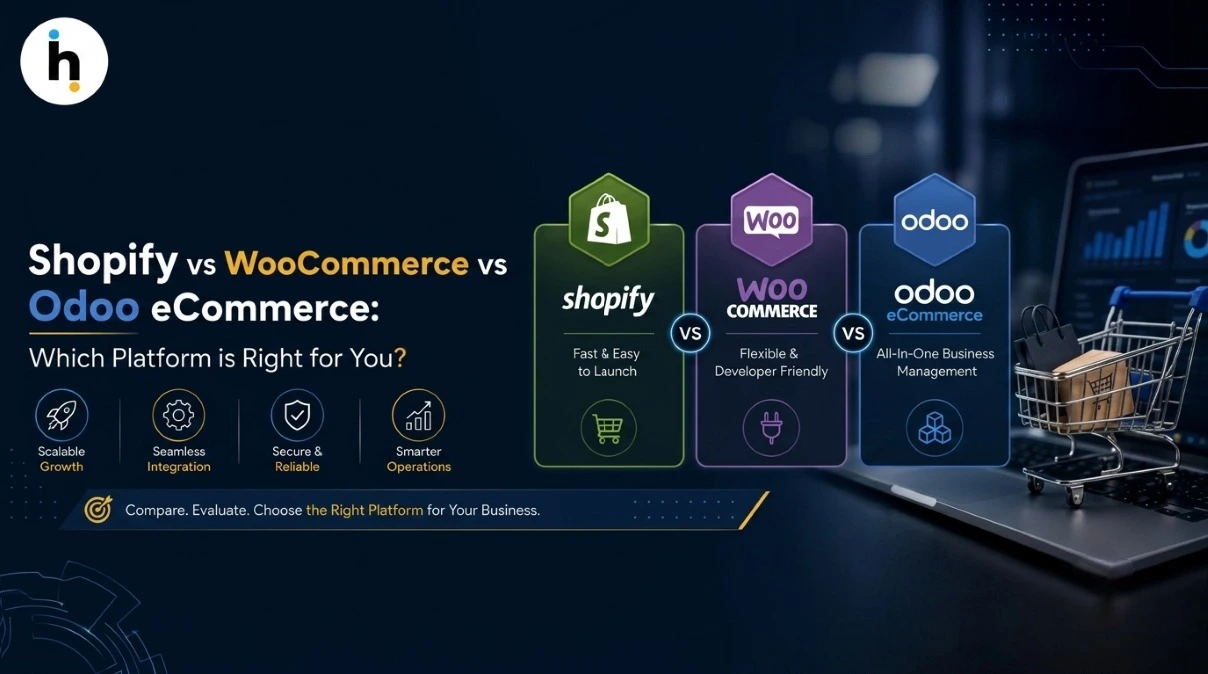
Shopify vs WooCommerce vs Odoo eCommerce
Introduction
I've sat across from business owners who spent months on the wrong eCommerce platform. Some picked Shopify because a friend recommended it. Others chose WooCommerce because it was free. A few went with a custom build that cost more than expected and delivered less.
The platform decision shapes your daily operations, your team's workflow, and your ability to grow without hitting a wall two years from now. This guide walks through Shopify, WooCommerce, and Odoo eCommerce honestly, including where each one falls short.
What Are You Actually Choosing Between?
Shopify is a hosted eCommerce platform. You pay a monthly fee, and Shopify handles servers, security, and updates. It is purpose-built for online retail and nothing else.
WooCommerce is a free plugin that turns a WordPress website into an online store. You own the infrastructure, which means more flexibility but also more responsibility.
Odoo eCommerce is one module within a larger business management system. When you run a Shopify eCommerce website but need tighter control over inventory, manufacturing, or accounting, Odoo's integrated approach starts to look very different from the other two.
Shopify: Built for Speed, Not Complexity
Shopify suits businesses that want to launch fast without technical involvement. Within a day, you can have a working store with payment processing, shipping integrations, and a decent storefront. The platform handles traffic spikes on its own, and support is available around the clock.
Where it falls short is backend depth. Inventory sync, procurement, and accounting all live in separate tools. At a small scale that is manageable. As order volume grows, the patchwork of apps becomes harder to maintain and more expensive to run.
Businesses that need a proper odoo shopify integration often find themselves at this crossroads. The front end works, but the back end is fragmented.
Shopify Pricing (Approximate)
Basic: $39/month
Shopify: $105/month
Advanced: $399/month
Plus (enterprise): starts at $2,000/month
WooCommerce: Flexible, But You Own the Complexity
WooCommerce suits developers, agencies, and businesses with in-house technical capacity. The plugin itself is free. The cost comes from hosting, premium plugins, and development work, which you control entirely.
The downside is that owning the infrastructure means owning the problems. Security patches, plugin conflicts, and performance issues all fall on you. For businesses that need real-time inventory across multiple warehouses or automated procurement, WooCommerce does not go there without significant custom development.
WooCommerce Pricing (Approximate)
Plugin: free
Hosting: $20 to $200/month depending on traffic
Essential plugins: $200 to $1,000/year
Odoo eCommerce: When the Store Is Part of a Bigger Picture
Odoo eCommerce makes the most sense when the online store is one part of a larger operation. Manufacturers, distributors, and wholesalers often find that Shopify or WooCommerce handles the storefront fine, but the connection to the rest of the business is where things break down.
Odoo solves that by running everything in one system. The eCommerce module connects directly to inventory, purchasing, accounting, and CRM. A sale on the website updates stock levels immediately. A low-inventory trigger creates a purchase order automatically. The Odoo eCommerce implementation runs natively within the same database as every other module, with no middleware and no manual reconciliation.
Odoo also handles B2B eCommerce better than the other two out of the box. Customer-specific pricing, quote workflows, and credit limits are built in.
The Odoo implementation process requires proper planning around data migration and staff training. Organizations that skip that work end up with a system that technically runs but does not deliver what they expected.
Odoo Pricing (Approximate)
Odoo Community: free (open source)
Odoo Enterprise: starts around $24.90/user/month
Implementation: mid-market businesses typically budget $30,000 to $150,000
Odoo Shopify Integration: When You Do Not Have to Choose
Can a business run Shopify as the storefront and connect it to Odoo for backend operations? Yes.
An odoo shopify connector synchronizes products, inventory, orders, and customer data between the two platforms. Shopify handles the customer-facing experience. Odoo manages inventory, fulfillment, and accounting on the backend.
A poorly configured odoo ecommerce integration creates more problems than it solves. Duplicate records and inventory discrepancies are common when the setup is rushed. Hummingbird Innovations designs these integrations based on your specific workflows, not a generic template.
Which Platform Should You Choose?
Choose Shopify if you want to launch quickly and your backend operations do not require deep integration.
Choose WooCommerce if you are already on WordPress, have technical resources, and need flexibility that hosted platforms do not offer.
Choose Odoo eCommerce if your store is part of a larger operation involving warehouses, manufacturing, or complex B2B relationships.
Consider an Odoo Shopify integration if you have an established Shopify store but your operations are outgrowing what Shopify can manage on the backend.
Getting the Decision Right
Platform choices have long consequences. Getting it right from the start avoids a painful migration two years later.
The team at Hummingbird Innovations has helped businesses across manufacturing, distribution, and retail make exactly this call. If you want a conversation grounded in your actual situation, reach out to the team to talk through your options.
Frequently Asked Questions
Share This Article

Hummingbird Innovations LLP
Experts in ERP, CRM, software development, and digital transformation solutions for growing businesses.
Categories
Popular Tags
🚀
Need Expert Consultation?
Connect with our experts to discuss your software, ERP, CRM, or automation requirements.
Call us Directly Connect on WhatsappExplore Our Services
Helping businesses streamline operations, automate processes, and accelerate growth.
