What is Odoo ERP? A Complete Guide for Indian Businesses
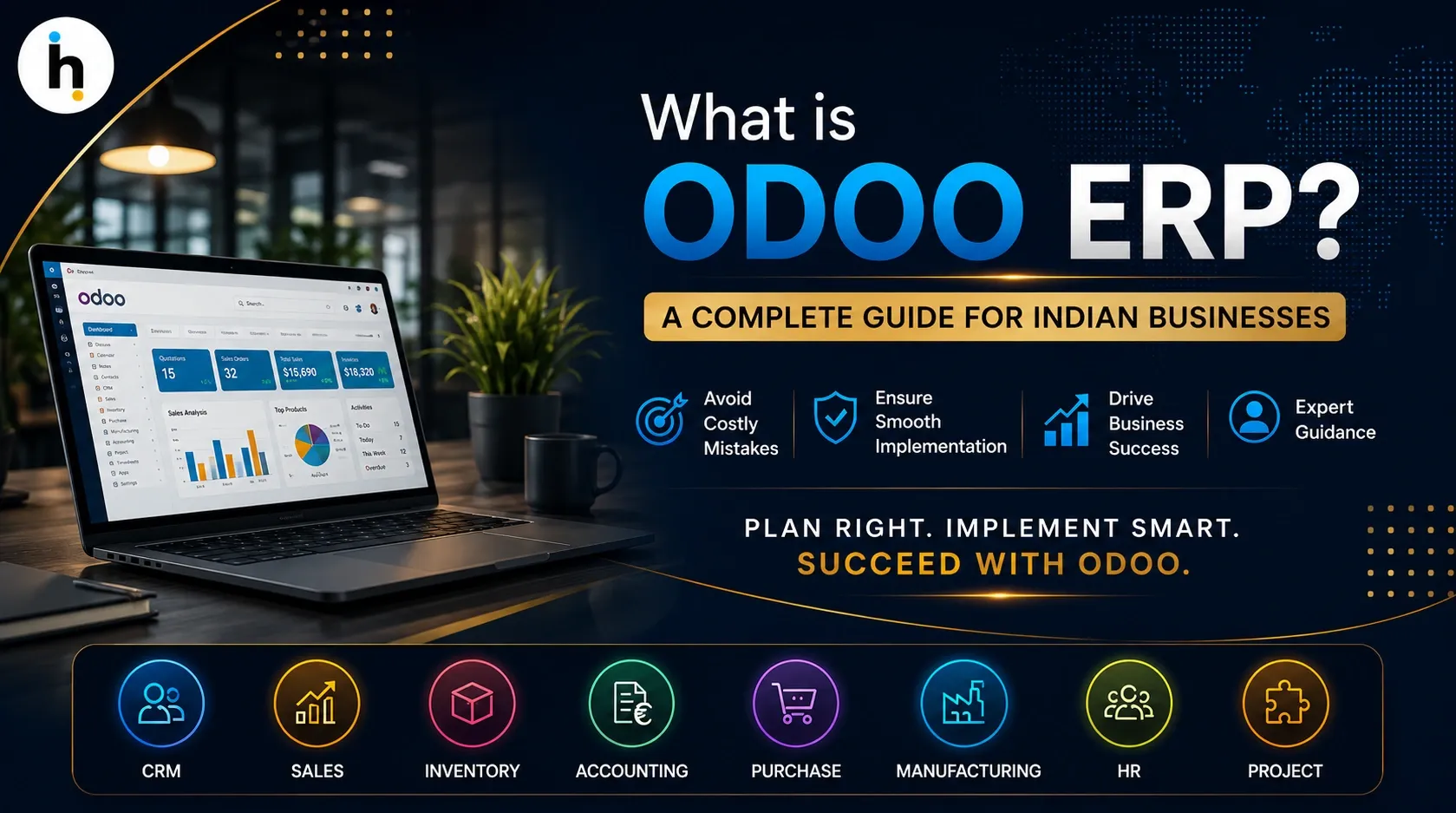
Odoo ERP is an open source business management platform that brings sales, inventory, accounting, manufacturing, HR, and customer relationship management into one connected system. For Indian businesses juggling spreadsheets, disconnected software, and manual reporting, Odoo ERP offers a practical path toward a single source of truth for daily operations.
This guide explains what Odoo ERP actually does, where businesses commonly go wrong during implementation, what it really costs, and how to choose a partner who can deliver a system that fits your business rather than a generic template.
What is Odoo ERP
Odoo ERP is built as a set of modules, covering sales, purchase, inventory, manufacturing, accounting, project management, and human resources. A business can start with two or three modules and add more as operations grow. This modular structure is one reason Odoo has gained traction among Indian SMEs, manufacturers, and retail chains that need functionality without paying for features they will never use.
Unlike older ERP systems that demanded heavy upfront licensing, Odoo works on a subscription and implementation cost model. That makes it accessible to smaller companies while still scaling to enterprise level operations.
At Hummingbird Innovations, we often see business owners assume Odoo is only for large manufacturers. In reality, a wholesale distributor with three warehouses or a clinic managing patient billing can benefit just as much from a properly configured system.
How Odoo ERP Works for Indian Businesses
Indian businesses have specific operational realities that global ERP platforms sometimes ignore. GST compliance, e-way bill generation, multi-state taxation, and vernacular invoicing are not optional extras — they are daily necessities.
A well configured Odoo ERP implementation handles these through localization modules and custom development where needed. For example, a textile manufacturer in Surat running job work orders across multiple units needs inventory tracking that reflects goods sent for processing, not just goods sold. Odoo can be configured for this, but only if the implementation team understands manufacturing workflows, not just software installation.
Industry Specific Applications
- Manufacturing companies use Odoo for production planning, bill of materials, and shop floor tracking.
- Retail businesses rely on point of sale integration connected directly to inventory and accounting.
- Wholesale businesses manage multi-location stock and batch pricing.
- Healthcare organizations track patient records, billing, and inventory of medical supplies.
- Educational institutes manage admissions, fee collection, and staff payroll from one dashboard.
Odoo ERP versus Traditional Business Management
Many Indian businesses still rely on Excel sheets, WhatsApp coordination, and separate accounting software. This works until the business crosses a certain size — and then errors, duplicate data entry, and delayed reporting start costing real money.
| Aspect | Traditional Methods | Odoo ERP |
|---|---|---|
| Data accuracy | Manual entry, prone to errors | Centralized, single data source |
| Reporting speed | Delayed, manual compilation | Real time dashboards |
| Departmental visibility | Siloed information | Connected across departments |
| Scalability | Difficult as operations grow | Modular and scalable |
| Compliance | Manual GST and tax handling | Automated compliance features |
| Cost over time | Hidden costs from inefficiency | Predictable subscription and support costs |
This is not to say every business needs ERP immediately. A five-person business with simple invoicing may not need it yet. But once a company manages inventory across locations or handles more than a handful of recurring vendors, spreadsheets tend to break down quietly — and that is usually when leadership notices numbers do not match.
Hidden Costs Businesses Often Overlook
Software licensing is rarely the real cost driver. Based on projects handled by Hummingbird Innovations, these are the costs businesses frequently underestimate.
- Data migration from legacy systems, especially when old records are inconsistent or incomplete.
- Staff training time, which affects productivity during the transition period.
- Custom module development for workflows that do not fit standard Odoo behavior.
- Third party integrations such as payment gateways, courier APIs, or existing accounting software.
- Ongoing support and version upgrades after going live.
- Internal change management, meaning the time managers spend getting staff to actually use the new system.
A realistic budget accounts for these from day one rather than treating them as surprises three months into the project.
Common Mistakes During Odoo ERP Implementation
Most failed ERP projects do not fail because of the software. They fail because of planning and process gaps.
- Skipping process mapping before configuration begins, resulting in a system that mirrors old inefficiencies instead of fixing them.
- Choosing a partner based purely on lowest quote rather than domain understanding.
- Underestimating the time needed for user acceptance testing.
- Trying to replicate every old spreadsheet feature instead of adapting to better workflows.
- Ignoring employee training until the week before launch.
- Treating go live as the finish line instead of the starting point for optimization.
Businesses that avoid these pitfalls generally see a smoother transition and faster return on investment.
Common Misconceptions About ERP Systems
There are a few beliefs that consistently lead businesses astray.
One is thinking ERP will automatically fix broken business processes. It will not. If your purchase approval process is disorganized on paper, digitizing it without redesign just makes the disorganization faster.
Another misconception is that customization equals better performance. Heavy customization often increases maintenance cost and complicates future upgrades.
A third misconception is that ERP implementation ends at go live. In practice, the first three to six months after launch involve the most learning and adjustment.
When Odoo ERP Customization Makes Sense
Odoo ERP customization is necessary when your business has workflows that standard modules genuinely cannot support, such as unique manufacturing sequences, specific approval hierarchies, or industry regulations that require particular documentation.
Customization should be avoided when the only reason is preference rather than necessity. If a standard Odoo feature already achieves the same business outcome with a small process adjustment, that is usually the better path. Unnecessary customization increases cost, slows down future upgrades, and creates dependency on whoever built it.
A good rule followed at Hummingbird Innovations is to configure first, customize only when configuration genuinely cannot meet a documented business requirement.
Choosing the Right Odoo ERP Implementation Company
Selecting an Odoo ERP implementation company is arguably more important than the software itself. Consider these factors.
- Industry experience relevant to your business type, not just general software experience.
- A clear discovery process before any development begins.
- Transparent pricing that separates licensing, implementation, customization, and support.
- Post launch support availability, since issues often surface weeks after going live.
- References from businesses of similar size and complexity.
Hummingbird Innovations approaches every project by first understanding operational reality on the ground, then mapping that to Odoo capabilities, rather than forcing a standard template onto a business that does not fit it.
Odoo ERP Integration and Payment Gateways
Odoo ERP integration extends the system beyond its native modules. Indian businesses commonly need integration with courier services, SMS gateways, WhatsApp business APIs, and accounting software already in use.
Odoo ERP payment gateway integrations matter particularly for retail and ecommerce businesses. Connecting Razorpay, PayU, or similar gateways directly into Odoo means payment status, invoicing, and inventory update automatically without manual reconciliation. This reduces errors during high volume sale periods and keeps accounting teams from chasing mismatched entries at month end.
Future ERP Trends for Indian Businesses
A few trends are shaping how Indian companies will use ERP platforms over the coming years.
- Greater reliance on AI powered forecasting for inventory and demand planning.
- Increased use of mobile first ERP access for field staff and warehouse teams.
- Deeper integration between ERP and government compliance portals.
- Growing adoption among mid sized manufacturers who previously relied only on accounting software.
- Rising demand for industry specific Odoo ERP customization services rather than generic setups.
Implementation Roadmap
- Discovery and process mapping
- Module selection and system design
- Configuration and any required custom development
- Data migration and validation
- User training and acceptance testing
- Go live and monitoring
- Post launch optimization and support
Business Readiness Checklist
- Documented current processes across departments
- Clear list of pain points the ERP should solve
- Defined budget including implementation and support
- Internal project owner assigned
- Staff informed and prepared for training
- Realistic timeline agreed with the implementation partner
Conclusion
Odoo ERP gives Indian businesses a genuine opportunity to replace fragmented systems with one connected platform, provided the implementation is planned carefully and customization is applied only where truly needed. Success depends less on the software itself and more on process clarity, realistic budgeting, and choosing a partner who understands your industry.
If you are evaluating Odoo ERP for your business, Hummingbird Innovations can help you map your current operations, identify the right modules, and plan an implementation that fits your actual workflow rather than a generic setup. A short discovery conversation is often the best starting point before committing to any timeline or budget.
Frequently Asked Questions
Share This Article

Hummingbird Innovations LLP
Experts in ERP, CRM, software development, and digital transformation solutions for growing businesses.
Categories
Popular Tags
🚀
Need Expert Consultation?
Connect with our experts to discuss your software, ERP, CRM, or automation requirements.
Call us Directly Connect on WhatsappExplore Our Services
Helping businesses streamline operations, automate processes, and accelerate growth.
